
 Translate
Vashon-Maury Island Marine Recovery Area
Short URL: kingcounty.gov/MRA
A Marine Recovery Area (MRA) was established in 2008 in parts of Vashon-Maury Island to comply with state law to protect especially sensitive marine waters from pollution from poorly functioning or failing on-site sewage systems. Since then, over 400 acres of Puget Sound shoreline have been upgraded, Public Health has started an inspection rebate program, and over 65% of properties comply with state inspection requirements for septic systems each year. This shows that water quality has consistently improved over the past decade, largely due to homeowners' investments in regular septic maintenance.
Proposed Marine Recovery Area update
Public Health is proposing to update the Vashon-Maury MRA. This is needed based on new shellfish data from the Washington State Department of Health, tribal treaty rights, and state law requirements to protect water from failing septic systems. In partnership with a Vashon-Maury Island advisory committee, Public Health is proposing the following changes.
- Expand the MRA to include all shoreline properties, where pollution risk is highest.
- Establish procedures for property exemptions when septic systems are not a high risk to shoreline water quality (for example when the septic system is on a bluff, far away from the shoreline).
- Adjust septic inspection requirements to better evaluate septic system pollution risk.
We're committed to supporting property owners in protecting their investments in shoreline properties. Public Health will provide septic system maintenance and financial assistance information to all property owners in the MRA. Public Health will work with property owners to understand and prepare for MRA requirements, and we will not enforce inspections until 3 years after the MRA update.
What does the proposed expansion mean for me?
Properties in the updated MRA will be required to have their septic system inspected by a certified maintainer within 3 years of the expansion and continue to have inspections as frequently as determined by the MRA development process (see more information below). By making sure that septic systems are inspected, small problems can be fixed before they get more expensive.
A process will be established for property owners to request exemption if it can be clearly established that their septic system does not present a risk of direct discharge to the shoreline.
Public Health will provide septic system maintenance and financial assistance information to all property owners in the MRA.
How has the MRA helped improve water quality?
Water quality has consistently improved since the MRA was created, which is largely due to homeowner’s investment in septic maintenance. We use commercial shellfish harvest classifications as one way to understand water quality. The below graph shows the number of acres reclassified as approved for shellfish harvesting around VMI as a result of septic maintenance efforts throughout the years since MRA was implemented. The labels (e.g. “Outer Quartermaster Harbor MRA”) highlight specific septic maintenance efforts that resulted in the acres being approved.
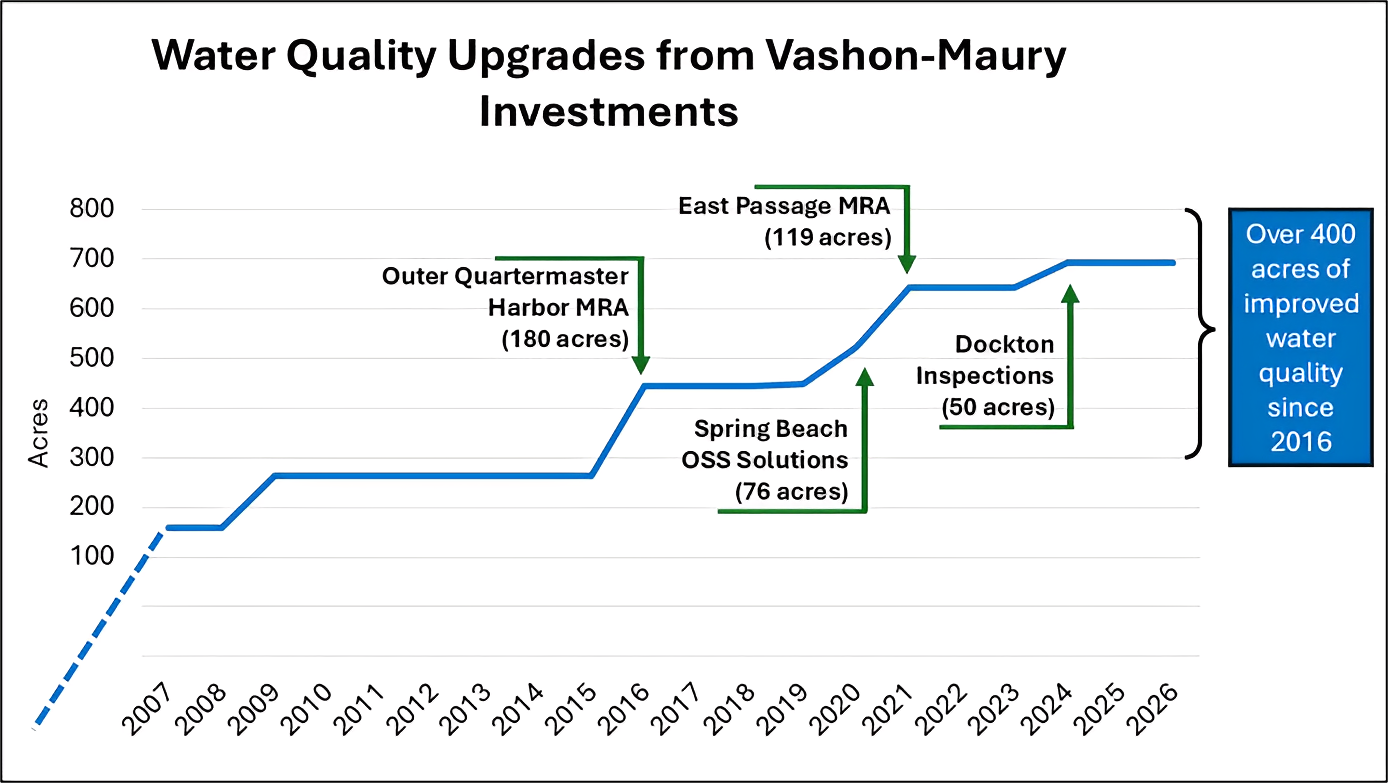
Accessible version of the above graph: Water quality upgrades from Vashon-Maury investments (Over 400 acres of improved water quality since 2016)
-
2016
Outer Quartermaster Harbor MRA (180 acres)
-
2020
Spring Beach OSS Solutions (76 acres) -
2021
East Passage MRA (119 acres)
-
2024
Dockton inspections (50 acres)
Project timeline and process
- December 2025: Established Vashon-Maury Island Marine Recovery Area Advisory Committee, with representatives from community residents, realtors, Groundwater Protection Committee, Puyallup Tribe, and Vashon Team Septic.
- January-May 2026: Reviewed septic system and water quality data to develop proposals.
- June-August 2026: Collect information and questions from interested parties to prepare to support property owners in MRA update implementation
- September 2026: On-site Sewage System Technical Advisory Committee reviews proposals.
- October 2026: Briefing to King County Board of Health
- November 2026: King County Board of Health vote
Frequently Asked Questions
In 2006, state law required Puget Sound counties (including King County) to designate MRAs where shellfish growing areas are closed due to bacterial pollution from septic systems, if closure is likely, or where bacteria or nitrogen are seriously affecting water quality. The MRA in King County was established because parts of Vashon-Maury Island were closed for commercial and recreational shellfish harvesting.
Public Health is proposing to update the Vashon-Maury MRA based on new data from the Washington State Department of Health (DOH), tribal treaty rights, and state law requirements to protect water from failing septic systems.
DOH’s most recent shellfish surveys found that effective septic management is needed to upgrade VMI shellfish growing areas along Colvos Passage from “Prohibited” to “Approved.” Further, more information about septic system status is needed on other VMI shoreline properties to classify additional VMI shellfish growing areas that are currently “Unclassified.” Washington State law requires that each county identify steps to manage pollution from septic systems, particularly in high-risk areas like shellfish growing areas, in local management plans. King County’s Local Management Plan notes that MRAs should be updated based on available data.
The current VMI MRA has been shown to be a very successful model in working with shoreline property owners to maintain septic systems and lead to water quality improvements. Including all VMI shoreline properties in the MRA is a clear and equal designation of highest-risk septic systems (if a shoreline septic system has problems, it’s very likely the sewage will get into the water).
As such, Public Health is proposing to expand the MRA to all VMI shoreline properties to protect water quality, ensure tribal treaty rights, and meet state requirements. Expanding the MRA will also help protect shoreline property investments and keep beaches healthy for wading, kayaking, shellfish harvest, and fishing.
The goal of the MRA is to keep pollution from septic system out of Puget Sound. If a septic system on shoreline properties has problems, there is a high likelihood that the sewage will get onto the beach and into the water. By including all shoreline properties, the MRA boundary is a clear and equal designation of highest-risk septic systems.
We are evaluating several options for inspection requirements to check septic systems along the shoreline. We are looking for feedback on the below proposed options.
- Option 1: Keep current MRA inspection requirements. All septic systems in the MRA have to be inspected annually by a certified maintainer. This costs about $435 per year ($400 for the inspection cost, $35 for the reporting fee).
- Option 2: Change MRA inspection requirements based on risk to water quality. An inspection by a certified maintainer would be required every three years for a permitted gravity system and every year for other system types. Additionally, high- risk septic systems that are closer to the water or close to the end of their expected lifespan would be evaluated in greater detail through shoreline sampling and a possible dye test every 9 years. This would cost about $200 per year for gravity septic systems and $585 per year for other septic systems ($185 reporting fee).
A septic system inspection usually costs $300-400. The OSS Maintenance Rebate Program is available to help with inspection costs. Septic system repairs and replacement costs vary widely. Some fixes are simple and only cost a few hundred dollars. If a new septic system is needed, this usually costs $40,000-50,000. Financial assistance is available for these costs too.
When septic systems don’t fully treat sewage, germs in wastewater flow through the soil on properties and onto the beach. These germs can then get sucked into filter-feeding shellfish or be swallowed by kids who are swimming, causing people to get sick.
The first step is to know where your septic system is located. You can find your property’s record drawing on the Septic Records Search. Make sure you put only human organics, toilet paper, and a small amount of chemicals or food scraps down the drain. Spread out water usage by doing laundry and running dishwasher at different times. Lastly, learn about local septic resources and opportunities like Vashon Team Septic (Septic Sisters) and the Septic Self-check pilot program.
A property owner may request an exemption to MRA inspection requirements if the property meets the following conditions.
- Initial MRA inspection shows that OSS is operating as designed without deficiencies
- Approved OSS record drawing exists
- OSS is over 100 feet from the shoreline
Public Health will evaluate the exemption request to determine if the risk of sewage discharge to the beach is low.
Current Marine Recovery Area Maps
Current MRA detailed maps show the individual parcels within each section of the MRA. The individual parcels are color-coded to show the level of information available in the Public Health—Seattle and King County records. This color-coding is done for each on-site sewage system. View the map legend for details.
Quartermaster Harbor Maps from north to south
- Governor's Lane, Section A (294 KB)
- Governor's Lane, Section B (322 KB)
- Shawnee-Magnolia Beach (450 KB)
- Harbor Heights, Section A (419 KB)
- Harbor Heights, Section B (343 KB)
- Tahlequah 125th PL SW areas (323 KB)
East Passage maps from north to south
- Dolphin Point (324 KB)
- Glen Acres (338 KB)
- Hawthorne (320 KB)
- Klahanie (318 KB)
- Summerhurst (350 KB)
This project has been funded wholly or in part by the United States Environmental Protection Agency under assistance agreement PC-01J89801-1 to the Washington State Department of Health. The contents of this document do not necessarily reflect the views and policies of the Environmental Protection Agency, nor does mention of trade names or commercial products constitute endorsement or recommendation for use.